Saturday, 1:10pm. Table 6 wants two thalis, a paneer, and one of them less spicy. The captain shouts it through the pass. The tandoor hears “two paneer.” The less-spicy note never leaves the dining room. Twelve minutes later the guest sends a plate back, the cook fires a second one, and the first plate becomes staff food. Nobody can say what was ordered, because nothing was written down in the kitchen.
That piece of paper, or the card on the kitchen screen that stands in for it, is the kitchen order ticket. In India the trade still calls it a KOT. It is older than any POS. A hotel steward, a food-court runner, and a café cashier have all used one, even when it was a carbon pad. The software did not invent the ticket. It stopped the ticket from depending on who was close enough to hear.
What a kitchen order ticket is
A KOT is the kitchen’s copy of the order. It says which table, which token, or which takeaway. It lists each dish, how many, and the note the guest actually gave. It names the station that cooks those lines. It carries the time, so a ticket that has been sitting can be seen as old. It does not need the price, the GST line, or the UPI reference. Those belong on the bill the guest signs or pays.
The two slips answer two different people. The guest asks, “What am I paying?” The cook asks, “What do I fire, and for whom?” A house that uses one piece of paper for both questions makes the cook wait for the bill, or makes the guest read a kitchen scribble. QuickKOT keeps them apart: a kitchen ticket when the order is taken, and a bill when the money is collected.
Why the pass fails without one
A busy kitchen is a queue with fire in the middle. Memory is the first thing that drops. The captain remembers table 6 and forgets the note. The cook remembers the note and fires it for table 4. A runner picks up the right plate and walks it to the wrong four-top, because two tables ordered the same biryani and only one of them said “no egg.”
The cost is the second firing, the table that waits, and the next table whose order was bumped. It is also the argument at the pass. The dining room says the note was given. The kitchen says it was not on the docket. Without a ticket, both of them are telling the truth as they remember it. With a ticket, the note is either on the slip or it is not.
The same slip is the handover. The cook who started lunch goes on a break. The person who steps in should see what is already on the fire. A shouted order does not survive a shift change.
A dining room
In a restaurant the KOT is the contract between the floor and the pass. The captain takes the order at the table. The ticket should be in the kitchen before the captain is back at the next table, not when the guest asks for the bill an hour later. Courses, a less-spicy mark, a child’s portion, “sauce on the side”: if it is not on the ticket, the kitchen is guessing.
One dining room can still have more than one station. The tandoor, the curry section, and the cold larder do not stand at the same board. A single long slip that mixes every section makes each cook hunt for their lines while the other sections are already late. A KOT per station gives the tandoor only the breads and the kebabs, and the curry section only the gravies. The guest still has one table and, at the end, one bill. The kitchens had separate tickets because they have separate hands.
Tables move, friends join, and a party asks to split. Those stay on the open ticket. The kitchen still needs a slip when a line is added, and a cancel when a line comes off, so the pass does not plate a dish the table no longer wants. Moving seats is covered in merge and split restaurant tables. The paper under that move is still a KOT.
A café and a single kitchen
A 12-cover café, a sweet counter, a dhaba, a QSR window: one cook line, one bill. The temptation is to skip the ticket because “we can see the guest.” At noon the queue is at the glass and the cook is at the grill. They cannot see the modifier. “Oat milk,” “no onion,” “extra hot” die between the till and the pan if they live only in the cashier’s head.
On QuickKOT, Basic is free POS for restaurants for that floor. One manager, the order, the kitchen ticket, and the bill. Automatic printing of the KOT starts on for that login: a new postpaid ticket, a line added to an open ticket, and a cancel. The bill is its own slip, printed when the payment is taken. A café that sells forty bowls a day does not need a food-court layout. It still needs the bowl in front of the cook to match the bowl the guest asked for. The small-floor note is a café with a limited number of orders. The public page is restaurant POS.
A hotel with several kitchens
A hotel rarely has one pass. Breakfast, the coffee shop, the all-day restaurant, and the bar can share a guest who is on one folio and will not stand at three cashiers. They cannot share one kitchen docket. Room-service eggs are not the bar’s problem. A pour of wine is not the bakery’s problem. If every kitchen prints the whole order, the bar starts looking for a dish it will never make, and the bakery wonders why a whisky is on their rail.
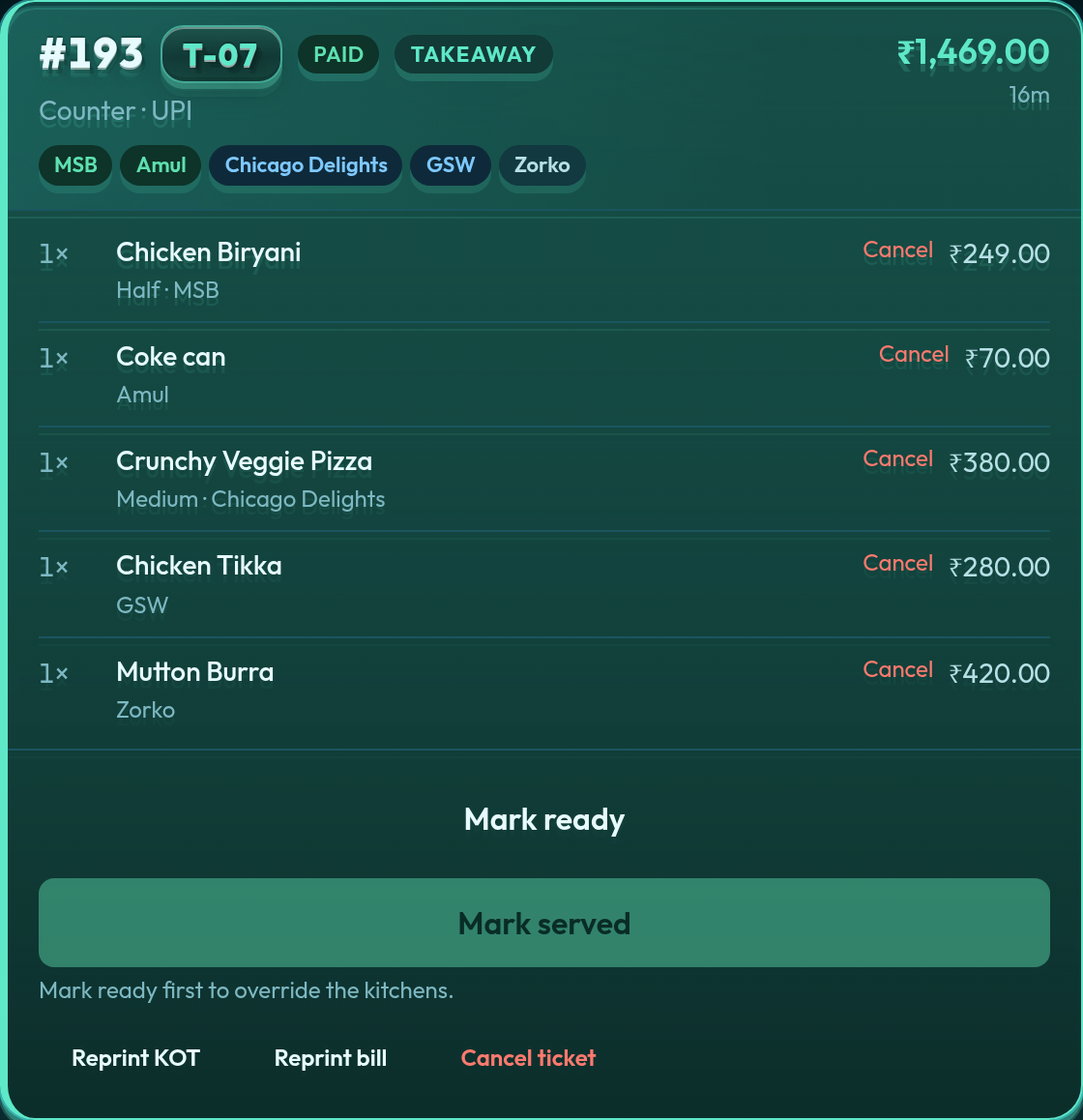
Centralised billing is the hotel shape: one guest check, a kitchen ticket per kitchen. The cashier rings biryani and a drink on the same order. The restaurant KOT carries the biryani. The bar KOT carries the drink. Each kitchen’s login sees its own lines. The F&B manager can still see the whole order, because someone has to know the guest is waiting on both. Mark served waits until every kitchen has handed off, so the tray does not leave with half the order and a promise.
After close, the guest still had one invoice and the kitchens still had their own tickets. The coffee shop’s morning is not buried in the specialty restaurant’s dinner. The hotel page is hotel POS with centralised billing, and the shared check is centralised billing for a hotel with more than one restaurant.
A food court, a canteen, a food hall
A court is the same idea with different owners at the stoves. The guest wants biryani from one stall and pizza from another, pays once, and collects from a board. Each stall must cook only its own lines. A shared KOT, or a shouted token with no slip, puts the pizza dough on the biryani pass and starts a fight about whose mistake it was.
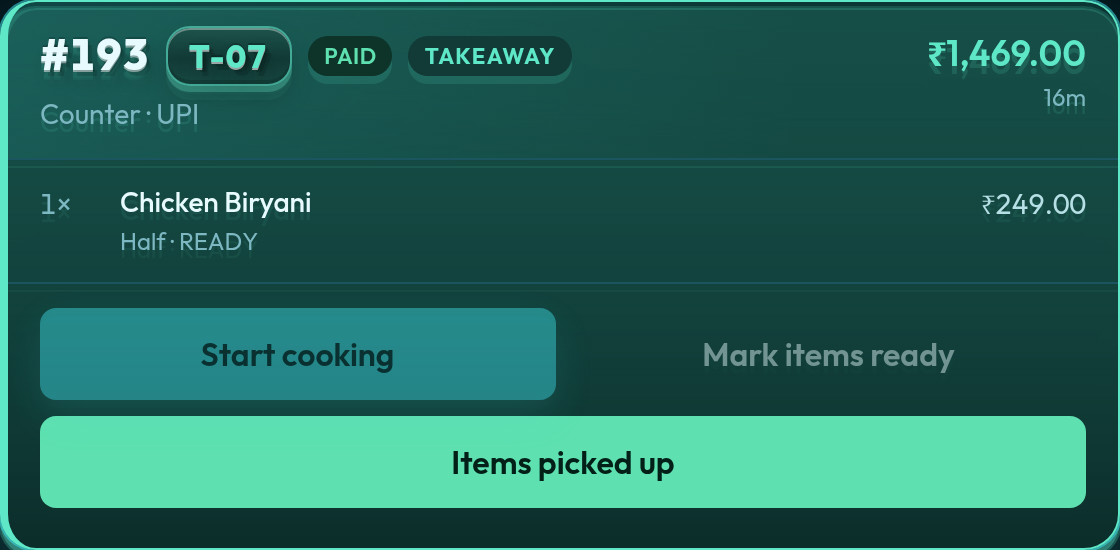
On a QuickKOT court, the category belongs to one stall. The order splits by itself. The biryani stall’s kitchen ticket is the biryani. The pizza stall’s kitchen ticket is the pizza. The court manager sees every stall on one card and does not mark the order served until each stall has handed the food off. The guest still receives one bill. The stalls never needed each other’s prices. They needed a ticket with their dishes and the token number, so pickup matches what they plated.
A college canteen or an office food hall has the same lunch: one till, a tandoor, a snack counter, a beverage stall. Settlement can wait until the month ends. The ticket cannot. If the snack counter fires from memory, the till and the counter disagree before anyone opens a spreadsheet. How the court bills is food court billing and the token display. The public page is food court POS.
What the slip has to carry
A useful KOT is short. The cook is reading it with wet hands, often at arm’s length, often while something else is in the pan. The lines that earn their place:
- Where it goes. Table 6, takeaway, or token 17. A hotel in-room order needs the outlet, not a guess.
- What to fire, and how many. “Paneer” without a quantity is how two portions become one.
- The note and the choice. Less spicy, no onion, the size, the add-on. A modifier that stays on the cashier’s screen never reaches the pan.
- Which kitchen. The station name on the slip, so a runner does not drop the tandoor ticket on the curry pass.
- When it was taken. A ticket with a time can be seen as late. A ticket with no time is just paper in a pile.
- Who took it. When the note is wrong, the kitchen knows which captain to ask, instead of asking the whole floor.
What does not belong is the guest’s payment mix, the tax breakup, and the restaurant’s bank details. Those slow the cook down and they belong on the bill. A KOT that tries to be a bill gets greasy, gets ignored, and stops being a kitchen document.
One slip for each kitchen, then a bill of its own
QuickKOT prints each kitchen’s ticket as its own job, then the bill as its own job. A thermal cutter can cut between them. A mixed order does not become one ribbon that a stall has to tear by hand. The slip is the narrow ticket that sits on an 80mm roll, which is the paper most passes already own.
Automatic KOT printing starts on for each login. It covers a new postpaid ticket, an item added after the first fire, a cancelled item, and a cancelled ticket. The added line prints as an additional item for that station, so the pass does not refire the dishes that are already on the plate. A cancel prints as cancelled, so a dish that left the order does not still get plated because the first slip is still on the rail. The bill follows the payment, on its own tick. Those ticks can be changed for one order. Reprint still runs when the first slip jammed, faded, or walked off on the bottom of a gastronorm.
Each person keeps their own print choice. The captain who wants a KOT and the night manager who does not can disagree without changing the house. Turning automatic printing off does not remove the ticket from the kitchen display. It only stops that login’s printer.
Paper and the screen are the same order
Some passes still want paper, because of oil, steam, and a thumb on a card. Some want only the screen. QuickKOT keeps both on the same order. The kitchen display is the live card: start, ready, picked up. The KOT is those lines, printed. A stall login sees that stall. A hotel kitchen sees that kitchen. On a centralised floor the house still sees the whole order, because the guest is one guest.
Who may open which screen is why a café, a food court, and a hotel should not share one login. The ticket only has to make sure the person at the stove sees their lines without opening the bill.
The ticket is also the clock
Once a KOT exists, the house can ask a question that shouting cannot answer. How long did this kitchen take from the moment the order existed to the moment that kitchen marked ready? Sales say what left the pass. They do not say that the tandoor was twenty minutes behind the grill. That clock is kitchen prep time, and it starts because the ticket has a time on it. A pass that never writes the order down cannot improve the pass. It can only remember the worst Saturday.
What a KOT is not
It is not a guest bill. Do not hand the kitchen slip to the table and call it the check. The guest needs the prices, the tax, and the payment. The cook needed the quantities.
It is not a stock ledger. Recipes, suppliers, and what the kitchen used against what was sold are inventory. A ticket can be right and the store can still be short. Those are different jobs.
It does not replace a person looking at the rail. A cancel slip tells the kitchen to stop. A printed cancel that nobody reads is the same as a shout nobody heard.
It is not one slip for a whole food court or a whole hotel. One guest bill, yes. One KOT for every kitchen on that order, no. The stall that does not sell the dish should not receive the dish.
Questions from the floor
What is a kitchen order ticket?
A kitchen order ticket, or KOT, is the slip the kitchen cooks from. It names the table or the token, the items, the quantities, and the notes. It is not the guest bill. The bill is for payment and tax. The KOT is for the pass.
Why should the kitchen not cook from the guest bill?
The bill carries prices, tax, and the payment. The cook needs quantity, the station, and the note (less spicy, no onion, the size). A bill also arrives when the guest is ready to pay, which is often after the food should already be on the fire. The KOT goes to the kitchen when the order is taken.
Does a food court or a hotel print one KOT for the whole order?
The guest still gets one bill. The kitchens do not share one slip. On centralised billing, each kitchen gets a KOT for the lines that belong to that kitchen. The biryani stall does not cook the pizza. The hotel bar does not fire the coffee shop’s eggs.
Does a small restaurant on Basic get a KOT?
Yes. Basic is free POS for restaurants: take the order, print a KOT, and collect the bill. One kitchen, one manager. Automatic KOT printing starts on for that login. The bill is a separate slip, printed when payment is taken.
The floors: restaurants, food courts, hotels. Plans are on pricing. Write to support@quickkot.com.
Self-serve signup is opening soon. Leave your details at app.quickkot.com/signup, see plans, or write to support@quickkot.com.